

Driving chains are an integral part of numerous mechanical systems, playing a crucial role in power transmission and motion control. As a leading supplier of driving chains, I am excited to share with you how these remarkable components work and their significance in various industries.
Basic Structure of Driving Chains
Before delving into how driving chains work, it's essential to understand their basic structure. A typical driving chain consists of a series of interconnected links. These links are usually made of high - strength materials such as steel to withstand the forces exerted during operation.
The most common types of driving chains include roller chains, toothed chains, and double - pitch conveyor chains. Roller chains are perhaps the most widely used. They are composed of inner plates, outer plates, pins, bushings, and rollers. The inner plates are connected by bushings, and the outer plates are connected by pins that pass through the bushings. The rollers are free to rotate on the bushings, which reduces friction when the chain engages with the sprocket.
Toothed chains, on the other hand, have teeth that mesh directly with the sprocket teeth. They offer smoother operation and higher precision compared to roller chains, making them suitable for applications where accurate timing is required. You can learn more about Toothed Chain on our website.
Double - pitch conveyor chains are designed for conveyor systems. They have a longer pitch than standard roller chains, which allows for greater spacing between the links. This makes them ideal for applications where large - scale material handling is involved. Check out our Double Pitch Conveyor Chain Sprocket for more details.
The Principle of Power Transmission
The primary function of a driving chain is to transmit power from one shaft to another. This is achieved through the interaction between the chain and the sprockets. Sprockets are toothed wheels that are mounted on the shafts. The teeth of the sprocket are designed to fit precisely into the links of the chain.
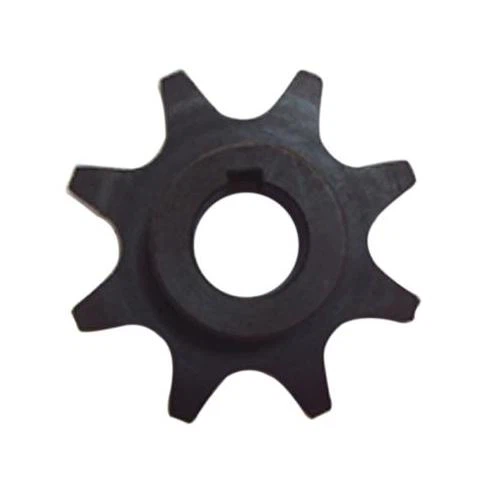

When the driving sprocket rotates, it pulls the chain along. The chain, in turn, transfers the motion to the driven sprocket. The power is transmitted through the tension in the chain. As the driving sprocket turns, it applies a force to the chain, causing it to move. The chain then exerts a force on the driven sprocket, making it rotate.
The ratio of the number of teeth on the driving sprocket to the number of teeth on the driven sprocket determines the speed and torque relationship between the two shafts. If the driving sprocket has more teeth than the driven sprocket, the driven shaft will rotate faster but with less torque. Conversely, if the driving sprocket has fewer teeth than the driven sprocket, the driven shaft will rotate slower but with more torque.
Advantages of Driving Chains in Power Transmission
There are several advantages to using driving chains for power transmission. Firstly, they offer high efficiency. Compared to other power - transmission methods such as belts, chains can transmit more power with less energy loss. This is because the positive engagement between the chain and the sprocket reduces slippage.
Secondly, driving chains can operate in a wide range of environmental conditions. They can withstand high temperatures, harsh chemicals, and heavy loads. This makes them suitable for use in industries such as mining, construction, and agriculture.
Thirdly, chains are relatively easy to install and maintain. They can be easily adjusted to accommodate different center distances between the shafts. Regular lubrication and inspection can ensure a long service life for the chain.
Applications of Driving Chains
Driving chains are used in a vast array of applications across different industries. In the automotive industry, they are used in engines to drive the camshafts and other auxiliary components. The Short Pitch Precision Roller Chains are often employed in these applications due to their high precision and reliability.
In the manufacturing industry, driving chains are used in conveyor systems to move materials from one point to another. Double - pitch conveyor chains are commonly used in these systems because of their ability to handle large - scale material handling.
In the agricultural sector, chains are used in tractors and other farming equipment for power transmission. They can withstand the rough conditions and heavy loads associated with agricultural work.
Factors Affecting the Performance of Driving Chains
Several factors can affect the performance of driving chains. One of the most important factors is lubrication. Proper lubrication reduces friction between the chain components, which helps to prevent wear and tear. It also dissipates heat generated during operation, prolonging the life of the chain.
The tension of the chain is another critical factor. If the chain is too loose, it may skip over the sprocket teeth, causing a loss of power transmission. On the other hand, if the chain is too tight, it can put excessive stress on the chain and the sprockets, leading to premature failure.
The quality of the chain and the sprockets also plays a significant role in performance. High - quality materials and precise manufacturing processes ensure that the chain and sprockets can withstand the forces and stresses during operation.
Maintenance of Driving Chains
To ensure the optimal performance and longevity of driving chains, regular maintenance is essential. This includes lubrication, tension adjustment, and inspection for wear and damage.
Lubrication should be carried out at regular intervals, depending on the operating conditions. The type of lubricant used should be suitable for the application. For example, in high - temperature environments, a high - temperature lubricant should be used.
Tension adjustment is also crucial. The chain tension should be checked periodically, and adjustments should be made as necessary. This can be done by adjusting the position of the sprockets or by using a tensioning device.
Inspection for wear and damage should be performed regularly. Look for signs of wear on the chain links, pins, bushings, and rollers. If any component shows excessive wear or damage, it should be replaced immediately to prevent further problems.
Why Choose Our Driving Chains
As a driving chain supplier, we are committed to providing high - quality products and excellent customer service. Our driving chains are made from the finest materials and are manufactured using advanced techniques to ensure superior performance and durability.
We offer a wide range of driving chains to meet the diverse needs of our customers. Whether you need a toothed chain for a high - precision application or a double - pitch conveyor chain for a large - scale material handling system, we have the right solution for you.
Our team of experts is always available to provide technical support and advice. We can help you select the most suitable chain for your application and offer guidance on installation, maintenance, and troubleshooting.
Contact Us for Purchasing
If you are interested in our driving chains or have any questions about how they work, please do not hesitate to contact us. We are eager to discuss your specific requirements and provide you with the best solutions. Our experienced sales team will be more than happy to assist you in the purchasing process. Start a conversation with us today and discover how our driving chains can enhance the performance of your mechanical systems.
References
- "Mechanical Engineering Design" by Joseph E. Shigley, Charles R. Mischke, and Richard G. Budynas.
- "Chain Drives: Selection, Installation, and Maintenance" by the American Chain Association.
